30+ years of developing and formulating for some the best-known supplement companies, I always strive for synergism between ingredients, vs simply throwing things together. I always look(ed) for specific mechanisms by which ingredients, when combined, would, or at least should “on paper” have benefits greater than the sum of their parts. That is, when taken together, provide an improved outcome over either alone. A perfect example of that is coffee and cocoa, hence the development of Alpha Joe Coffee Booster.
Potential Benefits of Combining Cocoa and Coffee
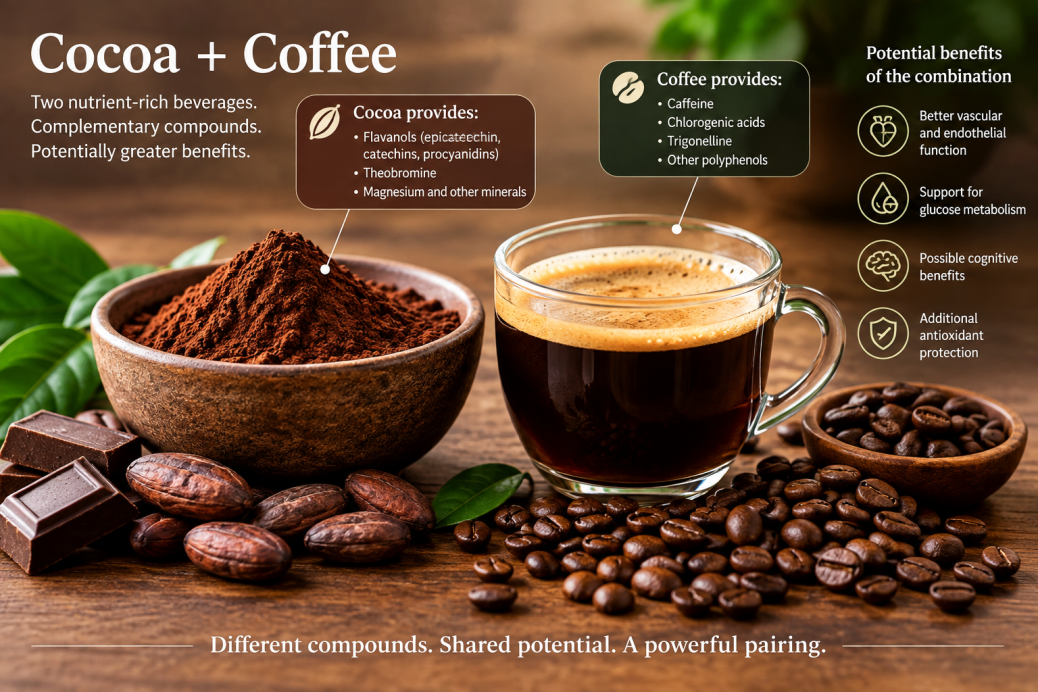
As covered on this site extensively over the years, both cocoa and coffee contain biologically active compounds, but they act through partly different pathways. Coffee provides caffeine, chlorogenic acids, trigonelline and other polyphenols, while cocoa contributes flavanols—particularly epicatechin and related procyanidins—as well as the methylxanthine theobromine. While more data is needed to clearly establish that combining them improves long-term health outcomes more than either alone, human and animal research provides a strong potential for their being complementary and synergistic effects.
A potentially important vascular combination
The strongest rationale for combining cocoa and coffee involves endothelial function. Cocoa flavanols can increase nitric-oxide signaling through effects involving endothelial nitric oxide synthase (eNOS). Increased nitric oxide promotes vasodilation and can improve blood-flow regulation. Flow-mediated dilation (FMD), a commonly used measure of endothelial function, has repeatedly improved following consumption of flavanol-rich cocoa.
Coffee may contribute through a different collection of compounds. Its chlorogenic acids and their metabolites have been associated with improvements in vascular function, while caffeine influences vascular and cellular signaling through adenosine-receptor pathways.
Particularly interesting is human research examining cocoa flavanols in combination with methylxanthines. Controlled studies found that methylxanthines enhanced the vascular response to cocoa flavanols, producing a greater improvement in FMD than cocoa flavanols alone. This is relevant because cocoa naturally supplies theobromine, while coffee supplies substantial caffeine as well as other bio active compounds, providing experimental support that cocoa flavanols and methylxanthines can interact beneficially.
Two complementary sources of polyphenols
Cocoa and coffee also provide substantially different polyphenolic profiles.
Cocoa contains epicatechin, catechins and procyanidins, whereas coffee is particularly rich in chlorogenic acids. These compounds can influence endothelial function, oxidative signaling, glucose metabolism and cellular signaling through overlapping but distinctly different mechanisms.
Consequently, combining the two may provide a broader range of bioactive compounds than consuming either beverage alone. Is the effect truly one of synergy or simply additive? A true synergistic effect means that the combined response exceeds what would be expected from simply adding the effects of the individual components. Direct human evidence demonstrating this for coffee plus cocoa remains limited, but compelling. Worst case is, the benefits are simply additive.
Metabolic effects
Cocoa flavanols have been investigated for effects on insulin sensitivity and glucose metabolism. Some randomized trials and meta-analyses report modest improvements in fasting glucose or measures of insulin resistance, although results have not been completely consistent and or dramatic.
Coffee has a much larger observational literature linking habitual consumption with a lower incidence of type 2 diabetes and other metabolic benefits. Coffee’s chlorogenic acids, caffeine, and other compounds may contribute to these effects.
It is therefore plausible that cocoa and coffee could have complementary metabolic effects, but more data is needed to definitively conclude that combining them produces a greater reduction in diabetes risk than either beverage separately. Regardless, perhaps the benefits are “just” additive vs truly synergistic. I still view it a big win for those ingesting both regularly.
Brain and cognitive effects
Coffee’s cognitive effects are well established: caffeine increases alertness, attention and wakefulness. Cocoa flavanols, meanwhile, have been shown increase cerebral blood flow in some experimental settings. This creates an appealing hypothesis that cocoa could complement coffee by improving cerebral perfusion while caffeine enhances alertness. Subjectively, people often report an enhanced alertness and mental focus by following my original recipe or using the coffee booster.
The importance of the cocoa used
The potential benefits depend heavily on flavanol content. As discussed in the main white paper article, Dutch or alkalized cocoa can lose substantial amounts of flavanols during processing. Conversely, minimally processed cocoa can retain more. Version Two of the coffee booster (coming soon!) will contain both non- alkalized cocoa and raw cacao, to further enhance flavanol content. Remember, not all cocoa or cacao are the same and both of them carefully selected for Alpha Joe Coffee Booster.
Bottom line
The combination of cocoa and coffee is biologically compelling because it brings together cocoa flavanols, coffee chlorogenic acids, epicatechin, caffeine and theobromine. The most promising potential benefit is enhanced vascular and endothelial function, with possible secondary effects on glucose metabolism and cerebral blood flow. However, evidence that the combination produces clinically meaningful reductions in cardiovascular events, diabetes, cognitive decline or mortality is currently lacking. It’s possible the potential benefits are more additive than synergistic, but benefits are the end result as the data strongly suggests.
The most scientifically defensible conclusion is that coffee plus flavanol-rich cocoa represents a promising complementary combination, particularly for vascular biology, but its proposed synergy remains an area for further human research rather than an established clinical effect. “But wait, there’s more!” as the old Ronco commercial would exclaim. There’s also the Creapure creatine and L-Tyrosine in the formula, which will add yet additional cognitive and neuro-protective effects, as well as systematic benefits be they synergistic or merely additive.

Will Brink is the owner of the Brinkzone Blog. Will has over 30 years experience as a respected author, columnist and consultant, to the supplement, fitness, bodybuilding, and weight loss industry and has been extensively published. Will graduated from Harvard University with a concentration in the natural sciences, and is a consultant to major supplement, dairy, and pharmaceutical companies.
His often ground breaking articles can be found in publications such as Lets Live, Muscle Media 2000, MuscleMag International, The Life Extension Magazine, Muscle n Fitness, Inside Karate, Exercise For Men Only, Body International, Power, Oxygen, Penthouse, Women’s World and The Townsend Letter For Doctors.
He’s also been published in peer reviewed journals.
Will is the author of the popular e-books, both accompanied by private members forum access , Bodybuilding Revealed & Fat Loss Revealed.
You can also buy Will’s other books on Amazon, Apple iBook, and Barnes and Noble.