In my recent write up on the possible synergy of cocoa and coffee, I wanted to add additional details to the main article on Alpha Joe Advanced Protein and the potential benefits of whey being combined with collagen. This article is an addendum to the main article on Advanced Protein and further explores the potential benefits of combining these two protein sources and why. To be clear, thirty plus years of researching whey protein and its many constituents and bio actives, whey remains the king of protein sources. That will never change in my view, but no protein is perfect, and that’s where and how collagen comes in. Whey protein and collagen are often discussed as competing protein supplements (they are not), but they are better understood as nutritionally complementary proteins. Their amino-acid profiles are remarkably different, and combining them may provide a broader spectrum of amino acids than either protein alone.
Whey is particularly rich in essential amino acids (EAAs), branched-chain amino acids (BCAAs), and leucine. Leucine is especially important because it acts as a key signal for stimulating muscle protein synthesis in part by activating the mTORC1 (mechanistic target of rapamycin complex 1) pathway. Whey is also a high-quality, rapidly digested protein containing all of the essential amino acids, including tryptophan. These characteristics make whey particularly useful for supporting muscle maintenance and adaptation to resistance exercise and prevention of sarcopenia. Finally, whey contains various bio active peptides and others that I have covered extensively on this site over the decades that really makes whey whey in my view, usually over looked by many. To summarize, whey is far more than its protein source or amino acid profile and content, it’s a bio active medicinal food.
Collagen, by contrast, is dominated by glycine, proline, and hydroxyproline—amino acids that are abundant in connective tissues. It contains little of several essential amino acids and essentially no tryptophan, making it an incomplete protein. As a protein source, collagen is a very poor choice. People that use collagen as a protein source are doing it wrong. Consequently, collagen is not an ideal substitute for a complete protein such as whey when the objective is maximizing the nutritional value of a protein feeding.
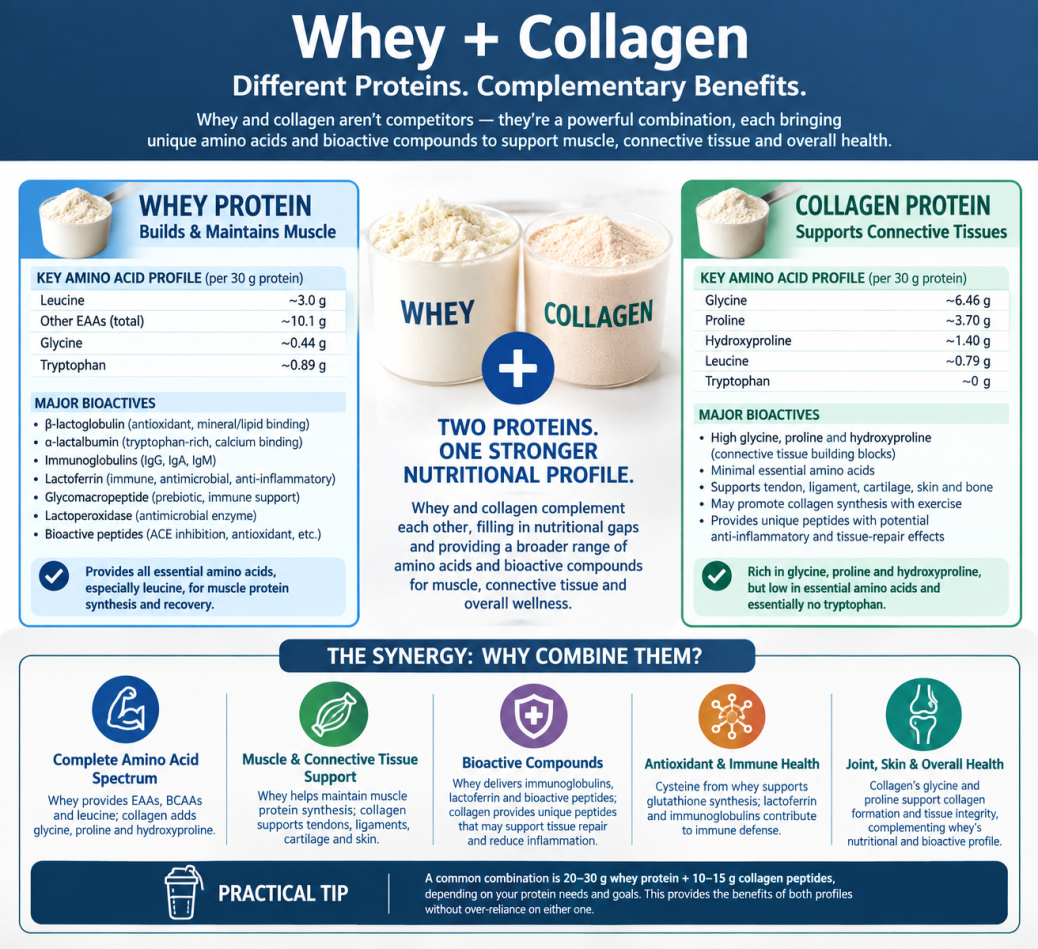
The differences become particularly striking when comparing glycine content. In one human feeding study, a 30-gram protein dose provided approximately 0.44 grams of glycine from whey versus 6.46 grams from collagen. Conversely, the whey beverage supplied approximately 3 grams of leucine, compared with only about 0.8 grams from collagen. Collagen also supplied essentially no tryptophan, whereas whey provided approximately 0.9 grams.
These differences suggest a rationale for combining the two, which is what I have advised for a decade or so, and what lead to the development of Advanced Protein.
In summary: Whey provides the essential-amino-acid foundation, while collagen substantially increases exposure to glycine, proline, and hydroxyproline.
This may be particularly relevant to people interested in maintaining both skeletal muscle and connective tissues in aging adults. Collagen peptides have been investigated for effects on tendons, ligaments, cartilage, skin, and other connective tissues. Some human studies suggest that consuming collagen or gelatin in conjunction with exercise can increase collagen synthesis or influence connective-tissue remodeling, although the magnitude and clinical importance of these effects remain areas of active research.
Glycine itself is also biologically interesting, especially in aging populations where glycine production may be reduced. It is a major component of collagen, participates in glutathione synthesis, contributes to bile-acid conjugation and other metabolic pathways, and functions as an inhibitory neurotransmitter in the nervous system. The fact that whey is relatively low in glycine while collagen is exceptionally rich in it provides a logical nutritional reason for combining the two. Is there real synergy there or simply additive? More data is needed to answer that Q… If whey has any Achilles’ heel in my view, it’s that it lacks glycine, especially as that applies to aging populations.
To repeat: collagen should not replace high-quality complete proteins. Large amounts of collagen used as a major protein source could dilute the intake of essential amino acids, particularly because collagen contains virtually no tryptophan and relatively little leucine. As a lone source of protein, it’s garbage. Collagen therefore makes more nutritional sense as an adjunct to an adequate intake of complete proteins rather than as a person’s primary protein source.
A practical combination might be 20–30 grams of whey protein together with 10–15 grams of collagen peptides, depending on total dietary protein requirements and individual goals. The whey supplies substantial leucine and EAAs, bio actives, etc., while the collagen adds a concentrated source of glycine and connective-tissue-associated amino acids. That’s win win in my view.
The bottom line is that whey and collagen are not simply two versions of the same supplement. One is an excellent protein source with various potential benefits (e.g., glutathione production, immune support, etc.) the other is not. They occupy different nutritional niches and are at the very least complimentary when combined, if not synergistic. Whey is particularly valuable for essential amino acids and muscle protein synthesis, while collagen provides an unusually concentrated source of glycine, proline, and hydroxyproline. Combining them may therefore be a rational strategy for obtaining the advantages of both protein profiles while avoiding the limitations of relying heavily on either one alone. I didn’t even discuss the inclusion of colostrum that exists in Advanced Protein, which has additional additive benefits, mostly from the bio actives found in high amount only in colostrum.

Will Brink is the owner of the Brinkzone Blog. Will has over 30 years experience as a respected author, columnist and consultant, to the supplement, fitness, bodybuilding, and weight loss industry and has been extensively published. Will graduated from Harvard University with a concentration in the natural sciences, and is a consultant to major supplement, dairy, and pharmaceutical companies.
His often ground breaking articles can be found in publications such as Lets Live, Muscle Media 2000, MuscleMag International, The Life Extension Magazine, Muscle n Fitness, Inside Karate, Exercise For Men Only, Body International, Power, Oxygen, Penthouse, Women’s World and The Townsend Letter For Doctors.
He’s also been published in peer reviewed journals.
Will is the author of the popular e-books, both accompanied by private members forum access , Bodybuilding Revealed & Fat Loss Revealed.
You can also buy Will’s other books on Amazon, Apple iBook, and Barnes and Noble.