Creatine vs. Guanidinoacetic Acid: The Next Big Thing?
I have been writing about the various potential benefits of creatine for 3+ decades now. I have been aware of the creatine precursor, Guanidinoacetic Acid (GAA) almost as long. Is GAA the next big thing now that creatine is finally getting the attention it should? Maybe…Creatine is one of the most extensively studied sports nutrition supplements on the planet, with substantial evidence supporting its benefits for muscle strength, high-intensity exercise performance, and lean mass development. You’d have to be living under a rock in a cave to not be aware of that. More recently, interest has expanded beyond skeletal muscle to include the brain, where creatine plays an important role in cellular energy metabolism. However, an intriguing alternative has emerged: guanidinoacetic acid (GAA), the immediate biochemical precursor of creatine.
Could GAA offer advantages over conventional creatine supplementation, particularly when it comes to increasing creatine concentrations in the brain? Preliminary human research suggests that possibility deserves closer examination.
Understanding the Biochemistry
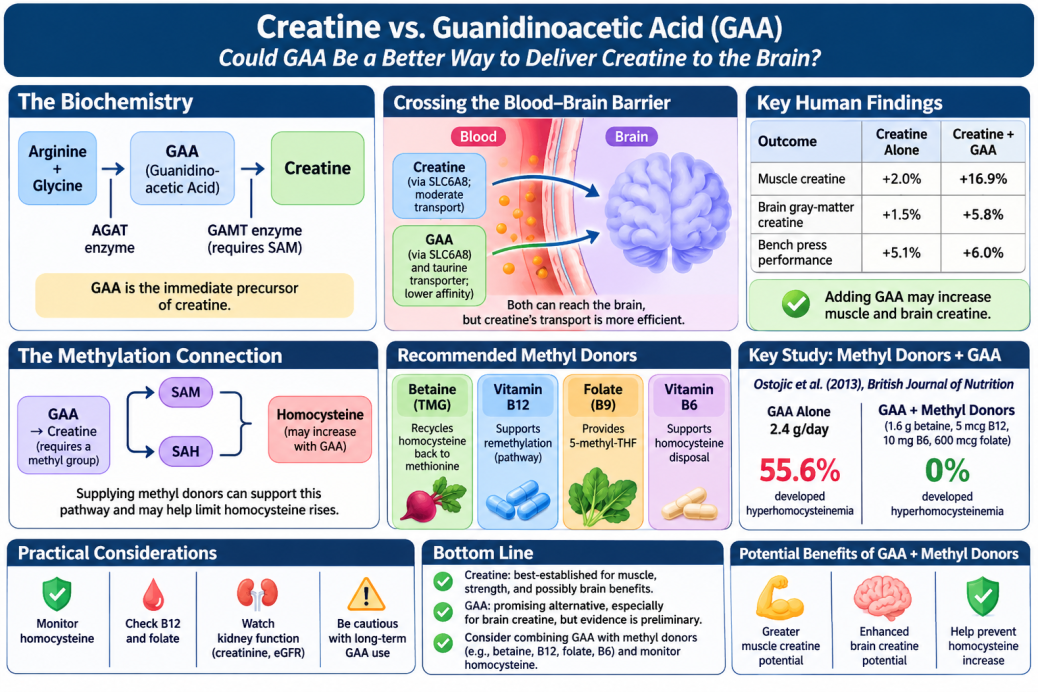
Creatine is synthesized primarily through a two-step process. First, arginine and glycine combine to produce GAA, a reaction involving the enzyme arginine amidinotransferase (AGAT). GAA is subsequently converted into creatine through the enzyme guanidinoacetate methyltransferase (GAMT), using S-adenosylmethionine (SAM) as its methyl donor. That last part is important, the methyl donor aspect is what has traditionally prevented further research with GAA, which will make more sense as this article progresses.
This second reaction is particularly important because it connects creatine production to the body’s methylation cycle. SAM donates a methyl group to GAA, producing creatine and S-adenosylhomocysteine, which is subsequently metabolized to homocysteine.
Supplementing creatine bypasses this synthetic pathway, whereas supplementing GAA increases the amount of substrate available for endogenous creatine production. As production of creatine from GAA is a major draw on the body’s methyl group availability, creatine supplementation has added benefits via methyl group availability for other important functions requiring methylation, a benefit I have mentioned in the past. So why consider the use of GAA?
The distinction becomes particularly interesting when considering the brain.
Crossing the Blood–Brain Barrier
Creatine does cross the blood–brain barrier (BBB), primarily through the creatine transporter SLC6A8. However, transport into the brain is relatively restricted compared with uptake into skeletal muscle. Consequently, oral creatine supplementation often produces more modest increases in brain creatine than in muscle tissue and likely requires much higher doses of creatine, as discussed recently.
GAA has different transport characteristics. Although it can interact with SLC6A8, its affinity for this transporter is substantially lower than creatine’s. Experimental research also suggests that GAA can interact with the taurine transporter. There may be other routes GAA crosses the BBB easier than creatine yet to be fully elucidated. The BBB often prefers precursor molecules for various reasons beyond the scope of this article.
Importantly, GAA must still be converted into creatine to contribute to the brain’s creatine and phosphocreatine pools. Its ability to enter the brain does not automatically mean that it will produce greater cerebral creatine availability but available data does suggest additional benefits from creatine alone and provides another potential route for influencing brain creatine metabolism.
Human Research: An Interesting Comparison
One particularly interesting human study was published in 2018. In a randomized crossover trial involving 14 healthy young men, researchers compared four weeks of creatine supplementation with a combination of creatine and GAA.
The combination group received 3 grams of creatine plus 1 gram of GAA daily, while the comparison group received 4 grams of creatine.
The results were noteworthy:
- Skeletal muscle creatine increased approximately 16.9% with the combination, compared with 2.0% with creatine alone.
- Brain gray-matter creatine increased approximately 5.8% with the combination, compared with 1.5% with creatine alone.
- Bench press performance improved approximately 6.0% with the combination and 5.1% with creatine alone.
These findings suggest that adding GAA may increase tissue creatine concentrations beyond what is achieved with creatine alone. The brain findings are particularly interesting because they suggest that GAA supplementation may influence cerebral creatine availability.
However, the study was small, and the observed biochemical differences did not establish a corresponding advantage in cognitive performance.
A 2024 pilot study involving 23 young adults investigated a combination of 2 grams of creatine and 2 grams of GAA compared with an equimolar creatine dose. Although differences in body-composition measurements were reported, the study did not establish clear superiority for muscle performance or functional outcomes.
More recently, an exploratory 2026 study in older adults compared GAA supplementation with an equimolar creatine dose over eight weeks. The study enrolled 25 participants, with 21 completing it. Handgrip strength improved significantly within the GAA group, and the between-group comparison favored GAA. Some muscle-related indices also improved. However, the small sample and exploratory design make it premature to draw firm conclusions.
The Methylation Question
As alluded to above, one potential disadvantage of GAA supplementation involves its conversion into creatine, a potential bottleneck of sorts worth examining.
Because GAMT requires SAM, increasing GAA availability can increase methyl-group utilization and potentially influence homocysteine metabolism.
A randomized human study published in 2014 examined GAA supplementation at doses of 1.2, 2.4, and 4.8 grams daily for six weeks. GAA increased circulating creatine, but homocysteine also increased by approximately 3.5 μmol/L across the GAA groups.
This is an important consideration because elevated homocysteine is associated with cardiovascular risk, although lowering homocysteine pharmacologically has not consistently translated into fewer cardiovascular events.
Interestingly, a separate 2018 study administering 3 grams of GAA daily for 12 weeks found no statistically significant change in global DNA methylation. This distinction matters: increased methylation demand does not necessarily translate into widespread DNA hypomethylation.
A 2025 study examining high-dose creatine, with and without GAA, also found no significant adverse effect on homocysteine over six weeks.
Taken together, these findings suggest that GAA’s methylation effects deserve further investigation but should not automatically be interpreted as evidence of widespread methylation impairment.
Safety and Future Research
Creatine monohydrate has an extensive human safety record, including research involving long-term supplementation. GAA has substantially less long-term human safety data.
Another consideration is that excessive GAA accumulation can be neurotoxic in individuals with guanidinoacetate methyltransferase deficiency. This inherited metabolic disorder illustrates why the ability to increase GAA availability in the brain should not automatically be regarded as beneficial.
Both creatine and GAA can also increase serum creatinine, potentially complicating interpretation of creatinine-based estimated glomerular filtration rate (eGFR). Cystatin C can provide additional information when assessing kidney function.
Larger, longer-duration randomized trials are needed to determine whether GAA meaningfully improves strength, muscle development, cognitive performance, or cerebral energy metabolism compared with creatine alone.
Conclusion
Creatine remains the best-established supplement for improving muscle creatine concentrations, strength, and high-intensity exercise performance. And BTW, not all creatine is created equal and I discuss that HERE. However, GAA represents an intriguing alternative and potential adjunct.
The most interesting finding so far is that combining GAA with creatine produced greater increases in measured muscle and brain creatine concentrations than creatine alone in a small human crossover trial.
Whether these biochemical changes translate into meaningful improvements in cognition, physical performance, or healthy aging remains unknown. Studies are in process as we speak, and I am in communication with one of the central researchers regularly.
For now, creatine monohydrate remains the evidence-based choice. GAA deserves further investigation, particularly as a possible strategy for influencing cerebral creatine metabolism, but its long-term safety and efficacy have not yet been established. I will add that the “fix” for the potential to raise homocysteine (even though studies examining that issue didn’t find an effect as discussed above…) is to take GAA with creatine and perhaps other supplements known to be methyl donors, such as Betaine (TMG), Vitamin B12, Folate (B9), and Vitamin B6 to name a few. That will likely address any potential issues involving methylation and may further support GAA -> creatine production. We already have data supporting that strategy, but more is needed.
Is GAA the next big thing? I do not see it ever replacing creatine, but very likely will be found to be a beneficial adjunct to it, especially where brain levels are concerned, which are impacted by age, various insults we all face, diseases, etc.
Selected References
- Creatine and guanidinoacetic acid supplementation and effects on muscle and brain creatine concentrations. 2018 human randomized crossover study.
- GAA supplementation and homocysteine metabolism. 2014 randomized human dose-ranging study.
- GAA supplementation and global DNA methylation. 2018 human study.
- Creatine and GAA supplementation: 2024 pilot study in young adults.
- GAA supplementation in older adults: 2026 exploratory clinical study.
- SLC6A8 and guanidinoacetic acid transport research. Experimental studies of creatine and GAA transport across the blood–brain barrier.

Will Brink is the owner of the Brinkzone Blog. Will has over 30 years experience as a respected author, columnist and consultant, to the supplement, fitness, bodybuilding, and weight loss industry and has been extensively published. Will graduated from Harvard University with a concentration in the natural sciences, and is a consultant to major supplement, dairy, and pharmaceutical companies.
His often ground breaking articles can be found in publications such as Lets Live, Muscle Media 2000, MuscleMag International, The Life Extension Magazine, Muscle n Fitness, Inside Karate, Exercise For Men Only, Body International, Power, Oxygen, Penthouse, Women’s World and The Townsend Letter For Doctors.
He’s also been published in peer reviewed journals.
Will is the author of the popular e-books, both accompanied by private members forum access , Bodybuilding Revealed & Fat Loss Revealed.
You can also buy Will’s other books on Amazon, Apple iBook, and Barnes and Noble.